Researchers have observed for the first time how nanoscale puddles of charge order move collectively in a layered superconductor. The results have been published in the journal Nano Letters.
In many quantum materials, electronic order forms in islands only a few nanometers wide, called “puddles.” Their arrangement in space is well mapped, but their dynamics in time – whether they move individually or collectively – have remained largely unknown. A team from IFW Dresden, TU Dresden, and the University of Naples Federico II has now observed collective oscillations of charge-order puddles in the layered superconductor 2H-NbSe₂.
Think of water on a pile of trays. Each layer of atoms is a tray with small puddles on it. When the trays slide back and forth, the water moves independently in each puddle. Below a characteristic temperature, however, all the puddles start to move together, in the same slow beat.
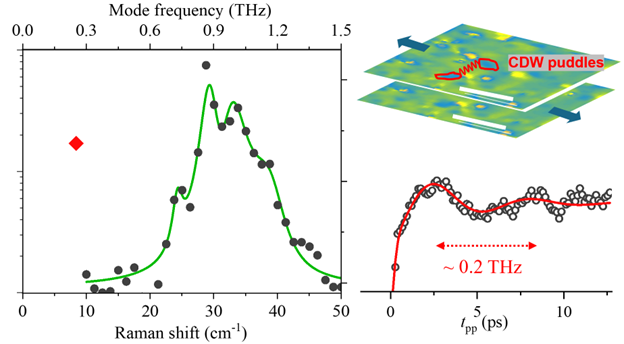
In the layered superconductor 2H-NbSe₂, a charge-density wave (CDW) forms below about 28 K. This is a periodic modulation of the electronic charge density that appears in locally confined regions, or puddles, about 10 nanometers wide. Below 7 K, the material also becomes superconducting.
The researchers have now detected similar collective oscillations in these nanoscale puddles. Using Raman scattering, the team found that the sliding vibrations of neighboring layers are strongly coupled to the charge-density wave, resulting in characteristic Fano interference. Ultrafast laser experiments revealed that below about 17 K, the puddles develop collective oscillations at a frequency of around 0.2 terahertz, accompanied by a sharp slowing down of the electronic dynamics.
The team interprets these observations as collective, glass-like dynamics of the puddles. They suggest that the interplay between the local charge orders and their coupling to lattice vibrations may contribute to this behavior. The results show how local puddle dynamics shape the global response of the material and may explain why charge order is much stronger in single atomic layers.
The Superpuddles Lab at IFW Dresden
Puddles are the focus of research at the Superpuddles Lab at IFW Dresden, led by Dr. Golam Haider and Prof. Dr. Nicola Poccia. Puddles are also what the lab's logo is made of. The lab explores how these nanoscale regions of electronic order form and move, and how their dynamics can be controlled. Its research focuses on two-dimensional superconductors and twisted architectures, with the aim of understanding the underlying physical processes and developing new approaches for superconducting quantum technologies.
“Puddles are not noise in quantum materials. They are where new physics happens,” says Nicola Poccia. “If we learn to see how they move and how to steer them, we can design superconducting devices from the puddle up, from twisted junctions to components for quantum superconducting technologies.”
“We can achieve this by tailoring light pulses to selectively drive and tune the collective dynamics of the puddles,” says Stefan Kaiser from TU Dresden.
“The puddles do not only sit still, they have their own rhythm. Understanding and controlling that rhythm allows us to define functionalities of future optoelectronic and quantum devices,” concludes Golam Haider.
Original publication
S. Kumbhakar, M. Esposito, A. Kumar N M et al., Dynamics of Charge-Density-Wave Puddles in 2H-NbSe₂. Nano Letters (2026), Open Access (CC BY 4.0).
https://doi.org/10.1021/acs.nanolett.6c03967
Partners
TU Dresden (Prof. Stefan Kaiser), University of Naples Federico II, Max Planck Institute for Chemical Physics of Solids, and University of Sharjah.
Funding
European Research Council (ERC-CoG 3DCuT, 101124606; ERC T-Higgs, 101044657), Deutsche Forschungsgemeinschaft (including the Cluster of Excellence ctd.qmat, EXC 2147, and SFB 1143), PNRR MUR NQSTI (PE0000023).
Contact
Dr. Golam Haider
Email: g.haider@ifw-dresden.de
Prof. Dr. Nicola Poccia
Email: n.poccia@ifw-dresden.de
Media Contact
Patricia Bäuchler
Email: p.baeuchler@ifw-dresden.de