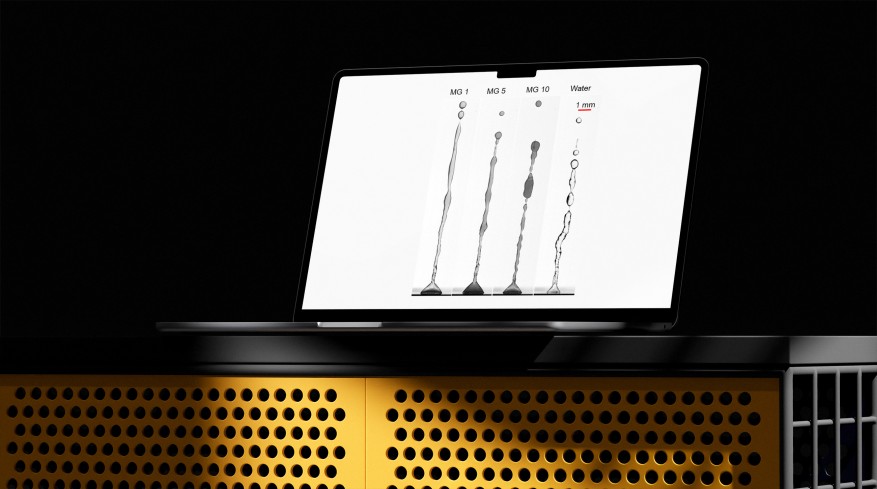
Tiny, soft polymer particles known as microgels can help keep ultrathin liquid jets stable for longer. This is the finding of a recent study led by researchers at TU Darmstadt with contributions from scientists at IFW Dresden. The results have now been published in Nature Communications.
For their experiments, the research team used surface acoustic waves to generate very thin water jets. They found that the softer the microgels, the longer the liquid jet remained stable. Computer simulations suggest that soft microgels can deform more easily at the interface between air and water while remaining connected to one another. In this way, interactions on the nanoscale can help stabilize a much larger liquid jet.
Ultrathin liquid jets generated by surface acoustic waves
For the experimental part of the study, IFW Dresden contributed its long-standing expertise in surface acoustic waves. Dr. Andreas Winkler and Dr. Mehrzad Roudini developed the acoustic experimental setup used to generate the ultrathin liquid jets. A specially designed chip produces surface acoustic waves at a frequency of around 64 megahertz, creating a liquid jet approximately 200 micrometers in diameter from a water droplet containing the microgels.
The use of surface acoustic waves to precisely manipulate and atomize very small volumes of liquid has been an area of research at IFW Dresden for many years. The Acoustic Microsystems research group develops microacoustic systems for applications including aerosol generation and precise liquid dispensing. The current study builds on this expertise and provides new insights into the stability of acoustically generated liquid jets.
The findings could be relevant for the further development of needle-free drug delivery systems and on-demand droplet sources. At IFW, particular attention is being paid to further optimizing the transducers that generate the acoustic waves and their electrical control.
The study “Soft microgel networks stabilize and extend nozzle-free water jets” has been published in Nature Communications.
Original publication:
Razavi, A., Roudini, M., Winkler, A., Liebchen, B., v. Klitzing, R., Mandal, S. and Rahimzadeh, A.: “Soft microgel networks stabilize and extend nozzle-free water jets”. Nature Communications 17, 8819 (2026).
https://doi.org/10.1038/s41467-026-76854-0
For more information about the study and its potential applications, see the press release from TU Darmstadt
Contact:
Patricia Bäuchler
Communication
p.baeuchler[at]ifw-dresden.de
TU Darmstadt
www.tu-darmstadt.de
presse[at]tu-darmstadt.de