

In today’s world where many governments and large private companies invest heavily in ever improving quantum computer systems, where artificial intelligence can potentially analyze any and all information exchange, inherently secure, robust and low-latency data communication is more important than ever before. Due to the shortcomings of current classical communication network architectures in these aspects, quantum communication is seen widely as an approach to attain physically secure, robust and low-latency exchange in future communication network systems. While enormous progress towards these goals has been achieved by the scientific community in the past two decades, realizing a fully integrated, scalable quantum (or hybrid quantum-classical) communication network systems beyond point-to-point links remains an unachieved principle goal, with much further research effort needed.
In this context, the research activities of the solid-state quantum photonics (SSQP) group aims at developing practical technological solutions for future fully integrated quantum communication networks. To this end the SSQP group currently focusses on two main topics: Efficient solid-state quantum light sources based on GaAs quantum dots and practical implementation of local area quantum communication networks.
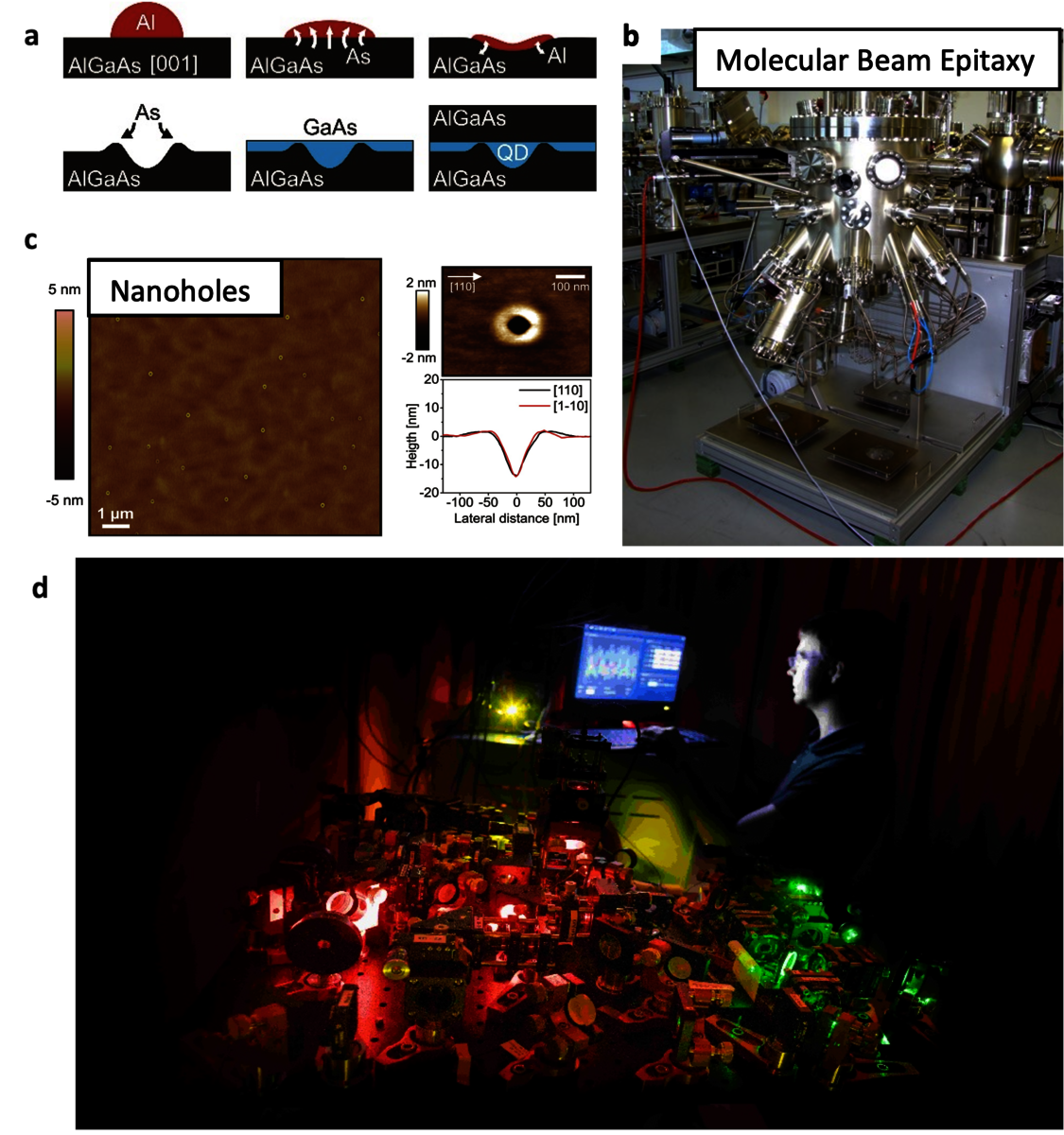
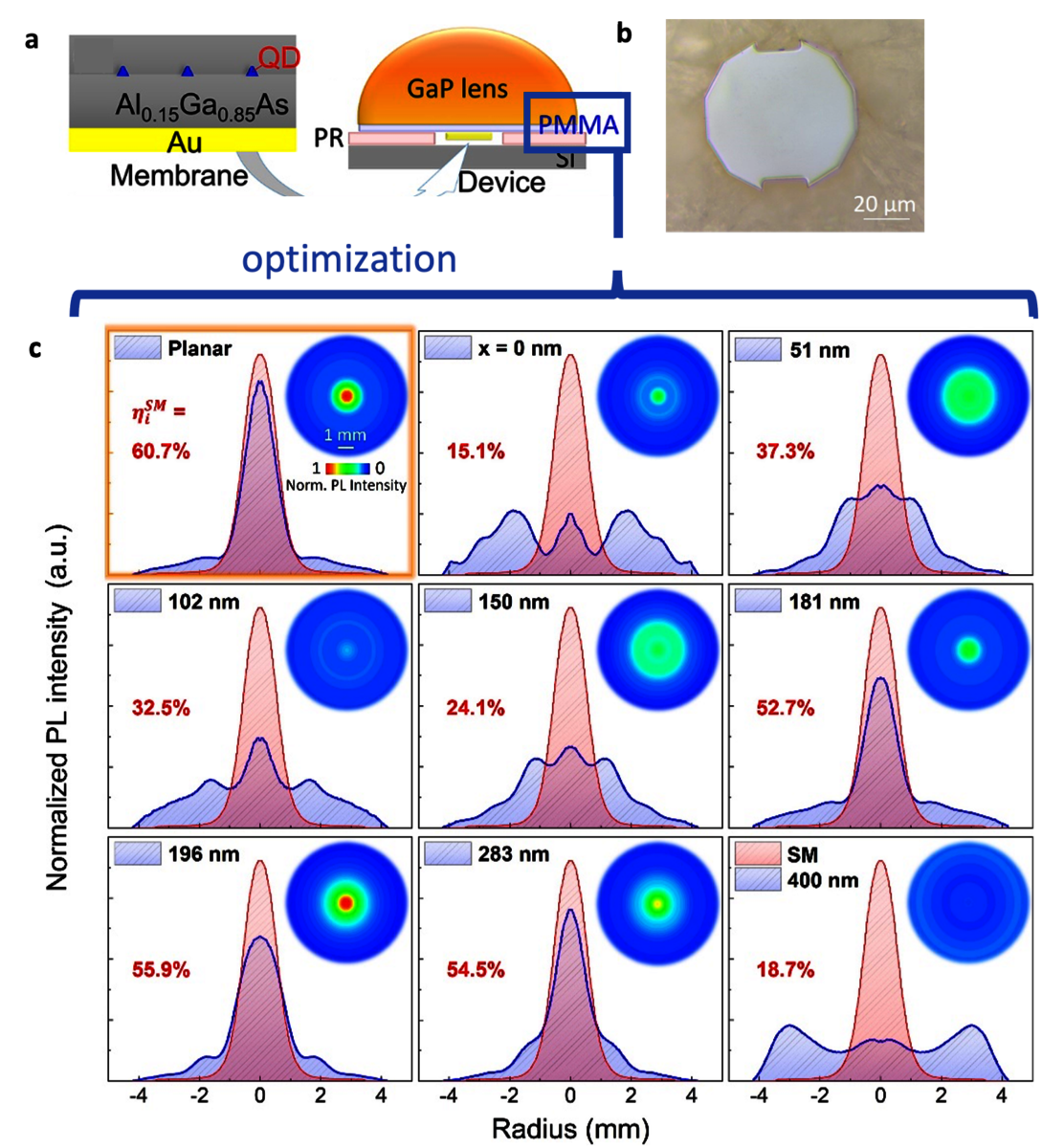
The SSQP group is one of the world leaders in the fabrication quantum light sources based on Gallium arsenide (GaAs) quantum dots. Specifically, we are focusing on high quality entangled photon pair sources – from wafer growth over device fabrication to quantum optical investigations. This is facilitated by a very diverse set of sophisticated materials science and quantum optical laboratories as well as usage of world-class clean room facilities at the IFW Dresden. One of our specialties is the fabrication of quantum dots embedded into nanomembranes, which allows precise placement of quantum dots to any planar surface and enables the creation of high yield semiconductor quantum light sources.
High-quality quantum dots are fabricated using in-situ droplet etching process during the epitaxial growth of a GaAs/AlGaAs heterostructure inside our molecular beam epitaxy machine, see also figure 1. The fabricated heterostructures are typically characterized using micro-photoluminescence spectroscopy as well as atomic force and electron beam microscopy to ensure consistent quantum dot quality. In a second step the quantum dots are processed into optical micro devices – such as quantum dot nanomembranes attached to Gallium phosphide solid immersion lenses or planar optical cavities - using optical and electron beam lithography as well as dry and wet chemical etching processes. This advanced processing is facilitated by the excellent clean room facilities of the IFW Dresden. Consequently, the produced quantum dot devices are investigated in our quantum optical laboratories. Possible investigations include deterministic GHz-clocked production of entangled photon pairs using resonant two-photon excitation, polarization resolved single photon correlation as well as polarization resolved high-resolution excitation spectroscopy. To this end instruments such as closed-cycle cryostats, high-resolution spectrometers, superconducting nanowire single photon detectors, time-resolved single photon counting electronics and quantum optical interferometers (e.g. Hong-Ou-Mandel) as well as a variety of continuous wave and pulsed laser sources are employed.
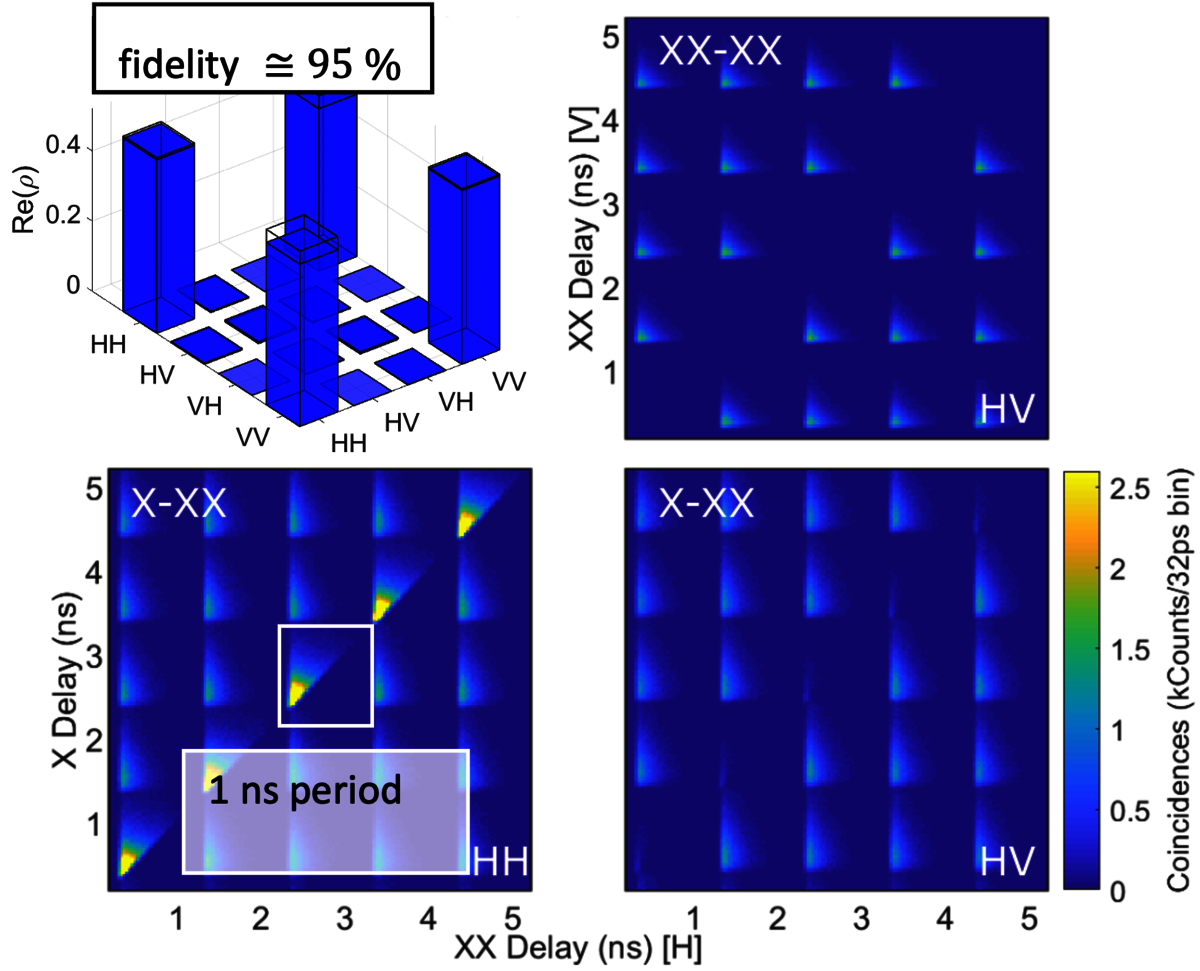
Using the described methods and facilities we were able to publish a number of research studies that document significant advances in the field of semiconductor-based quantum light sources. We were able to show that using droplet etched GaAs quantum dot devices deterministic and on demand GHz-clocked maximally entangled photon emission is possible [1]. Some core results are of this publication are illustrated in figure 2.
Current research interests include the realization of quantum repeater segments by combining our entangled photon sources with Diamond-based quantum memories and telecom wavelength long-range transport in the framework of the QR.X project of the German Federal Ministry of Education and Research (BMBF). The SSQP is member of the QR.X consortium and contributes to the ct.qmat excellence cluster for topological and complex quantum matter.
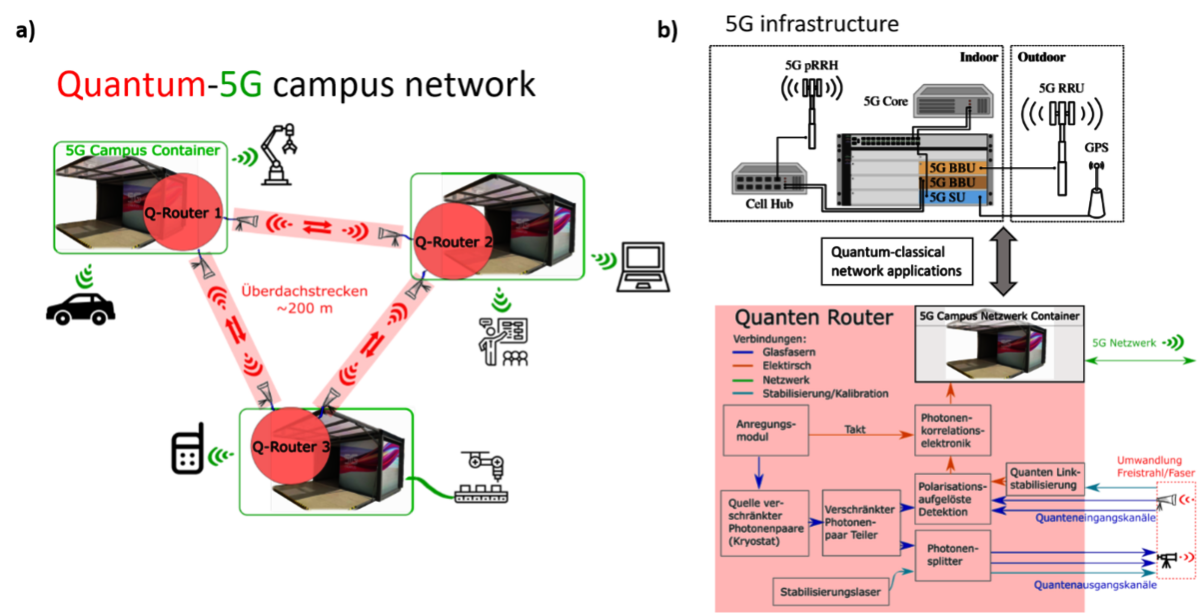

One important step towards fully integrated global scale quantum communication networks are encapsulated local area (‘campus’) networks which operate at moderate distances and number of devices. This approach avoids the issues of long-distance quantum communication, i.e. mostly the need for quantum repeaters, and limits the complexity and therefore allows for practical hardware and software integration and development of quantum information exchange into existing and future classical communication systems such as 5G and 6G. These thereby obtained hybrid quantum-classical systems intend to leverage an advantage from using quantum information exchange as one of the network services of classical communication systems and therefore aim at generating a quantum-advantage beyond secure quantum key distribution (QKD). The targeted quantum-advantages beyond QKD are therefore, quantum synchronization for ultra-low latency, shared randomness, distributed quantum sensing, as well as quantum random linear network coding. Another advantage of targeting these unexplored quantum-classical application scenarios is that they are potentially able provide a quantum-advantage without very high data throughput, which is a principle challenge of all current practical quantum communication schemes.
The SSPQ group cooperates closely with Prof. Bassoli and Prof. Fitzek of TU Dresden’s Deutsche Telekom Chair of Communication Networks – among other partners such as the Deutsche Telekom AG and the TU Munich - in order to realize an industry compatible quantum-5G network at the campus of the TU Dresden. These efforts are pursued in the context of the QD-CamNetz project consortium. The principle goal of this project is to build and develop a fully-integrated hardware and software implementation of a 5G-quantum campus network based on sharing of entangled photons between three 5G base stations – the so-called quantum router systems – by using GaAs quantum dot based entangled photon pair sources, see also Fig. 4.
Another interesting aspect of future quantum network systems, in which the SSPQ group is invested in, are quantum-enhanced ‘Internet-of-things’ systems. The goal of this research is to investigate how quantum network architectures and principles can be used beneficially for decentralized networks of small devices. The SSPQ group is specifically interested in these networks for distributed quantum metrology applications. These investigations are performed as part of the QUIET project consortium in which the SSPQ group collaborates with research groups of the TU Dresden, the TU Munich and the Deutsche Telekom AG. One of the principle goals of and main responsibility of SSQP group in this project is to build a distributed quantum metrology network demonstrator using the GaAs quantum dot spin qubits [2] as sensitive quantum sensors with an efficient optical readout interface. The distributed quantum sensing aspect is realized by the single photon interference of the optical signals of these sensors at a central server, see also Fig. 5. This project uses the same basic hardware infrastructure as QD-CamNetz project.
[1] C. Hopfmann, W. Nie, N. L. Sharma, C. Weigelt, F. Ding, and O. G. Schmidt, “Maximally entangled and gigahertz-clocked on-demand photon pair source,” Phys. Rev. B, vol. 103, no. 7, p. 75413, Feb. 2021, doi: 10.1103/PhysRevB.103.075413.
[2] C. Hopfmann, N. L. Sharma, W. Nie, R. Keil, F. Ding, and O. G. Schmidt, “Heralded preparation of spin qubits in droplet-etched GaAs quantum dots using quasiresonant excitation,” Phys. Rev. B, vol. 104, no. 7, p. 75301, Aug. 2021, doi: 10.1103/PhysRevB.104.075301.
[3] W. Nie, N. L. Sharma, C. Weigelt, C. Hopfmann, and O. G. Schmidt, “Experimental optimization of the fiber coupling efficiency of GaAs quantum dot-based photon sources,” Applied Physics Letters, Dec. 2021, dot: 10.1063/5.0059310.


