

Recent Highlights showcases scientific achievements, research breakthroughs andawards from across the Institute for Materials Chemistry. Together, these stories reflect the scientists, discoveries, and partnerships that shape materials research at IFW Dresden.
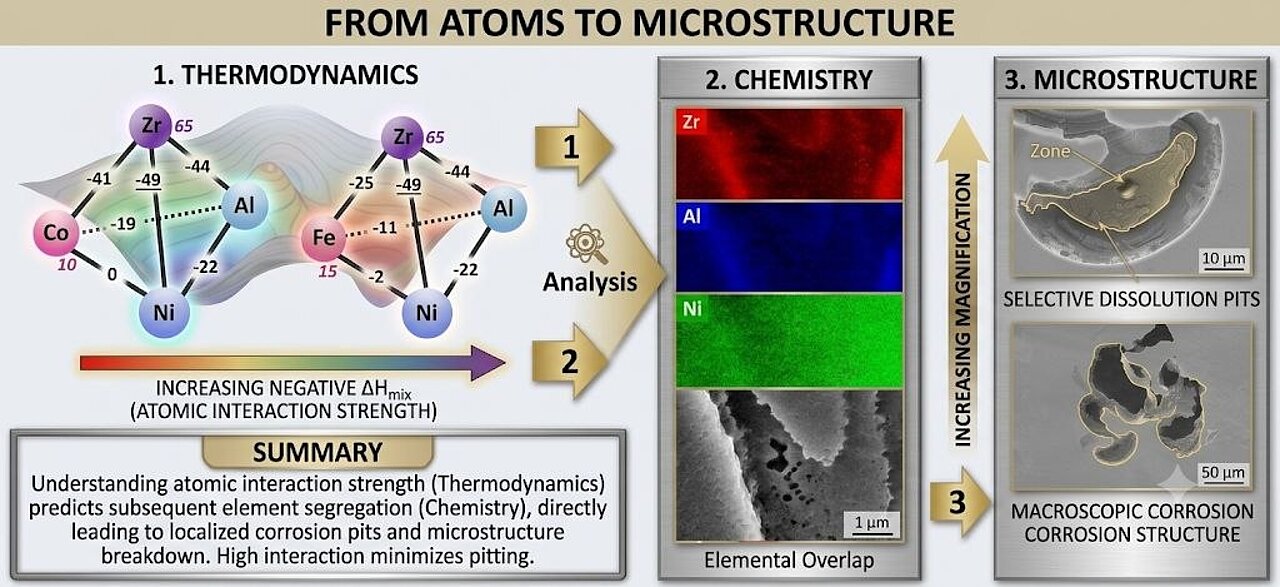
IMC breakthrough: Zr-based metallic glasses as precursors for nanoporous hydrogen evolution reaction catalysts
Researchers at the Institute for Materials Chemistry (IMC), part of the Leibniz Institute for Solid State and Materials Research Dresden (IFW Dresden), have taken a significant step towards sustainable energy production. Prof., Dr.-Eng. Viktoriia Shtefan and her colleagues, Dr. Ivan Kaban and Dr. Annett Gebert, have developed a novel approach to creating nanoporous surfaces from Zr-based metallic glasses for the efficient production of hydrogen via water splitting.
Their work focuses on gaining a fundamental understanding of the corrosion and electrochemical behaviour of Zr-Ni-Al-based metallic glasses alloyed with cobalt or iron. Through the systematic investigation of these materials in chloride and thiocyanate solutions, the researchers discovered that nanoscale pitting can be exploited as a surface engineering tool rather than a degradation process. Selecting the right potential and electrolyte composition allows for the selective dissolution of zirconium and aluminum, while leaving nickel, cobalt, and iron on the surface to form a precursor for catalytically active nanoporous structures.
This approach paves the way for the design of high-performance, non-precious metal catalysts for the hydrogen evolution reaction in alkaline water electrolysis, which is a key technology for green hydrogen production. The findings show that uniform nanoscale pitting at specific voltages can be used to create consistent, porous structures.
This work has been published in Corrosion Science, one of the leading journals in this area of research, and was presented by Prof. Shtefan at the 41-st Topical Meeting of the International Society of Electrochemistry (ISE) in Belgrade, Serbia, from 7 to 10 June 2026. Funding for the study was provided by the Deutsche Forschungsgemeinschaft (DFG, German Research Foundation) under project number 553576450 (SH 2178/1-1).
Original Publication:
V. Shtefan, I. Kaban, A. Gebert, "Electrochemical and corrosion behaviour of novel Zr–Ni(Co,Fe)–Al metallic glasses as precursors of nanostructured cathodes for water splitting", Corrosion Science 269 (2026) 113975.
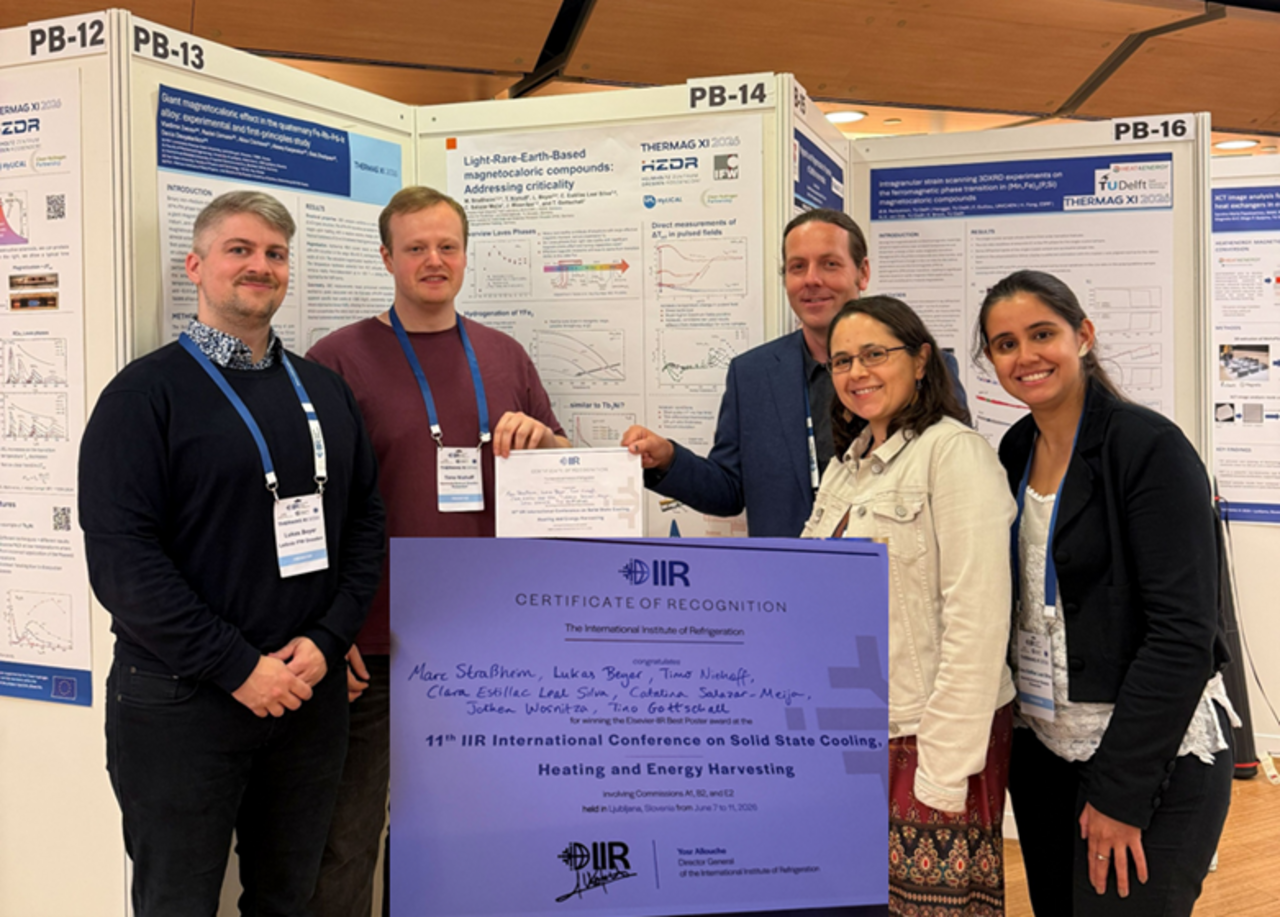
A joint research effort involving scientists from the Dresden High Magnetic Field Laboratory (HZDR), TU Dresden, TU Bergakademie Freiberg, and the Institute for Materials Chemistry (IMC) at IFW Dresden has been recognized with the Elsevier–IIR Best Poster Award at the Thermag XI Conference, held in Ljubljana, Slovenia, from 7–11 June 2026.
The awarded work, “Light-Rare-Earth-Based Magnetocaloric Compounds: Addressing Criticality,” explores alternative magnetocaloric materials based on light rare-earth elements. By reducing the dependence on critical heavy rare-earth resources while maintaining promising cooling performance, the research contributes to the development of more sustainable materials for future solid-state refrigeration and hydrogen technologies.
The IMC contribution, represented by Lukas Beyer, focused on the synthesis and materials-chemistry aspects of these advanced intermetallic compounds. Together with partners from HZDR and collaborating universities, the project combines expertise in materials design, structural characterization, and high-field magnetic measurements to better understand the relationship between composition, magnetic ordering, and magnetocaloric performance.
The research forms part of the European HyLICAL project, funded through the Clean Hydrogen Partnership, and highlights the importance of interdisciplinary collaboration in developing resource-conscious materials solutions for future energy and cooling technologies.
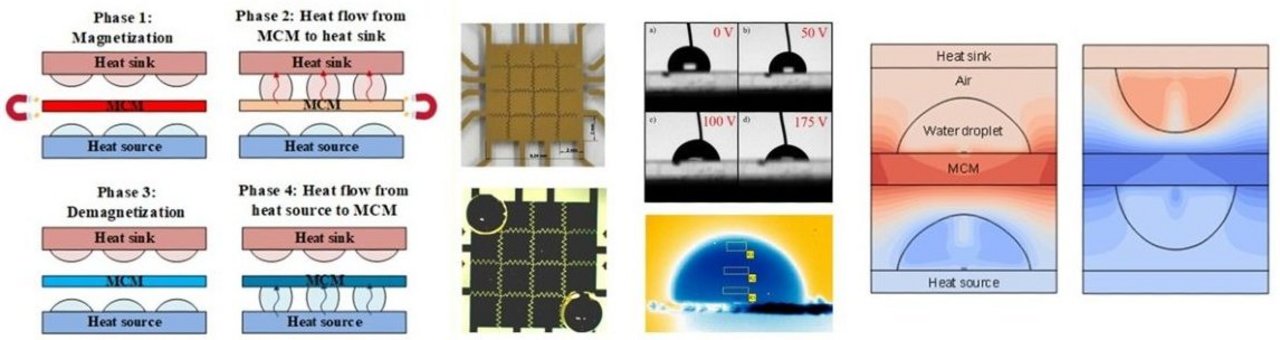
The international research project “Cool BatMan” has been selected by M-ERA.NET as one of its success stories, highlighting the project's contribution to innovative thermal management concepts for future battery technologies.
Bringing together researchers from the University of Ljubljana, the Jožef Stefan Institute, the Universitat de Barcelona, and IFW Dresden, the project investigated the dynamic thermal behavior of the magnetocaloric effect and electrowetting-on-dielectric, combining both phenomena within a novel compact cooling concept for battery thermal management systems.
At IMC, the project was represented by Prof. Dr. Jens Freudenberger and contributed to advancing fundamental understanding of functional materials and emerging cooling technologies for next-generation energy storage applications.
The project ran from April 2022 to March 2025 as part of the M-ERA.NET call on Functional Materials.
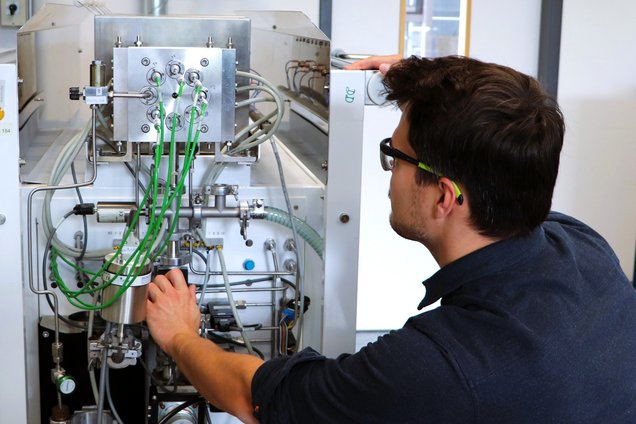
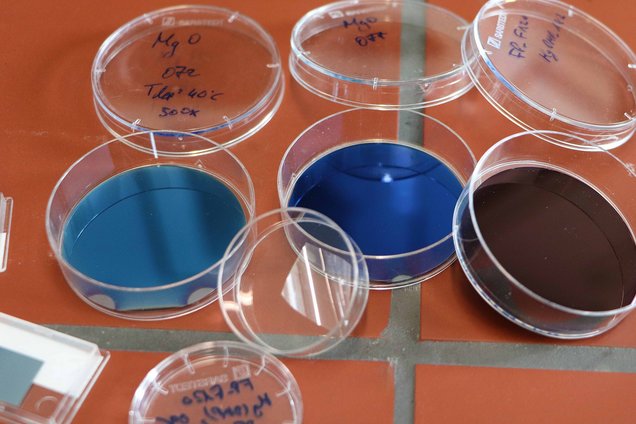
A major advance in thin-film technology has been achieved by researchers at the Institute for Materials Chemistry (IMC), part of the Leibniz Institute for Solid State and Materials Research Dresden (IFW Dresden). A team led by Prof. Dr. Anjana Devi and doctoral researcher Florian Preischel from the Molecules to Materials research group has developed a novel, non-pyrophoric magnesium precursor that enables the atomic layer deposition (ALD) of high-quality magnesium oxide (MgO) films at record-low temperatures — between 30 °C and 260 °C.
This breakthrough overcomes a key limitation in ALD: the need for high-temperature processing, which restricts applications on heat-sensitive substrates like polymer foils and flexible electronics. The new precursor combines high volatility, thermal stability, and strong reactivity — without the safety risks of earlier compounds.
The work, published in the Journal of the American Chemical Society (JACS), marks a critical step toward industrial scalability and real-world deployment. The findings open new pathways for MgO in protective coatings, biomedical implants, magnetic tunnel junctions (MTJs), and next-generation MRAM memory devices.
Florian Preischel was recognized for this work with the prestigious Dr. Tuomo Suntola Prize at the 2024 International ALD/ALE Conference in Helsinki.
Original Publication:
J. Am. Chem. Soc. 2025, 147, 35, 31764–31778
Link:
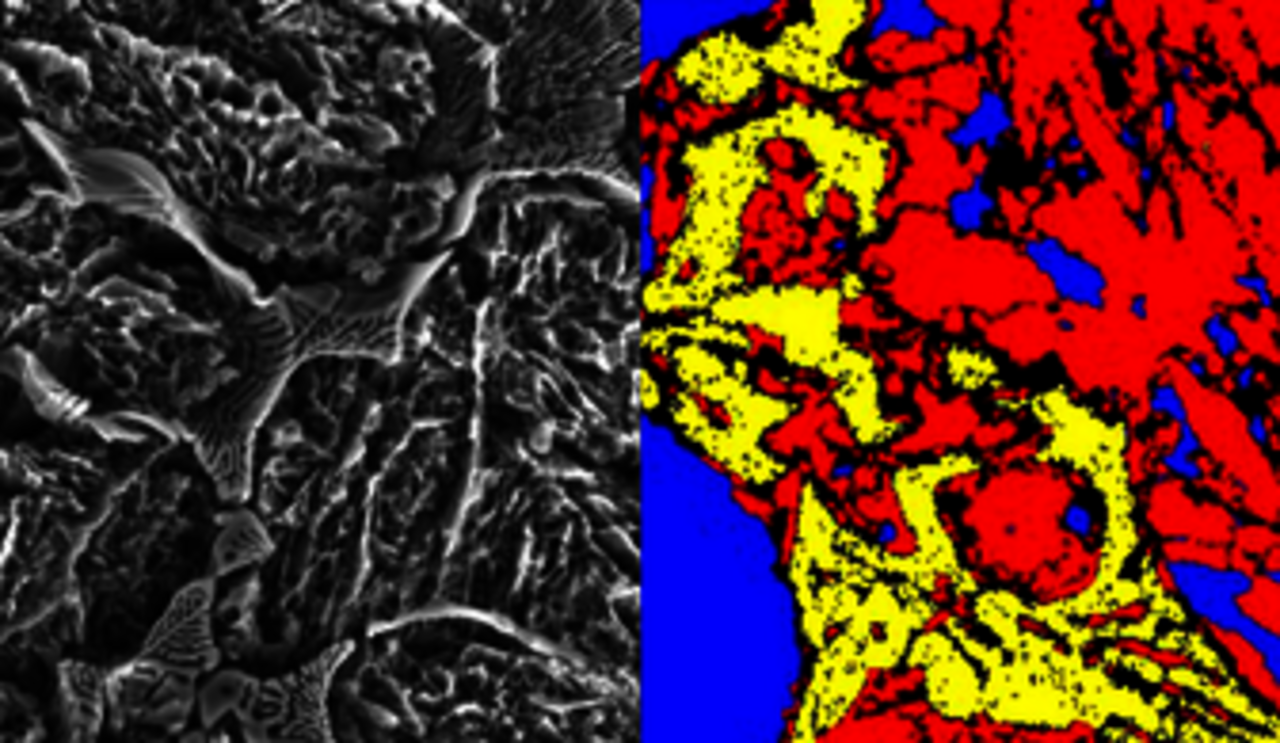
We are pleased to announce that the publication “Novel Corrosion-Resistant Tool Steels with Superior Wear Properties” has been selected as part of the Best of Advanced Engineering Materials – 2023 Editor’s Choice Collection. The article was highlighted by the editors of Advanced Engineering Materials as one of the journal’s outstanding contributions.
The research presents a novel class of high-strength cast tool steels that combine excellent wear resistance with enhanced corrosion resistance. Through tailored alloy design and advanced processing strategies, the team developed materials capable of meeting the demanding requirements of highly abrasive and corrosive operating environments. The work contributes to the development of more durable and resource-efficient tool materials for industrial applications.
The publication is the result of a successful collaboration between Josephine Zeisig, Lars Giebeler, Annett Gebert, Steffen Oswald, Uta Kühn, and Julia Hufenbach.
We warmly congratulate all authors on this recognition and the inclusion of their work in the Best of Advanced Engineering Materials – 2023 Edition.
Some parts of the news articles, image captions and alternative text for images are generated with the help of AI.
However, they are always approved and edited by human staff.
The seminar and lecture programs of the Institute for Materials Chemistry provide a platform for interdisciplinary dialogue, scientific discussion, and insight into current developments in materials science and chemistry. Discover those, where researchers, students, and invited guests come together to share ideas, discuss current research, and inspire scientific exchange:


