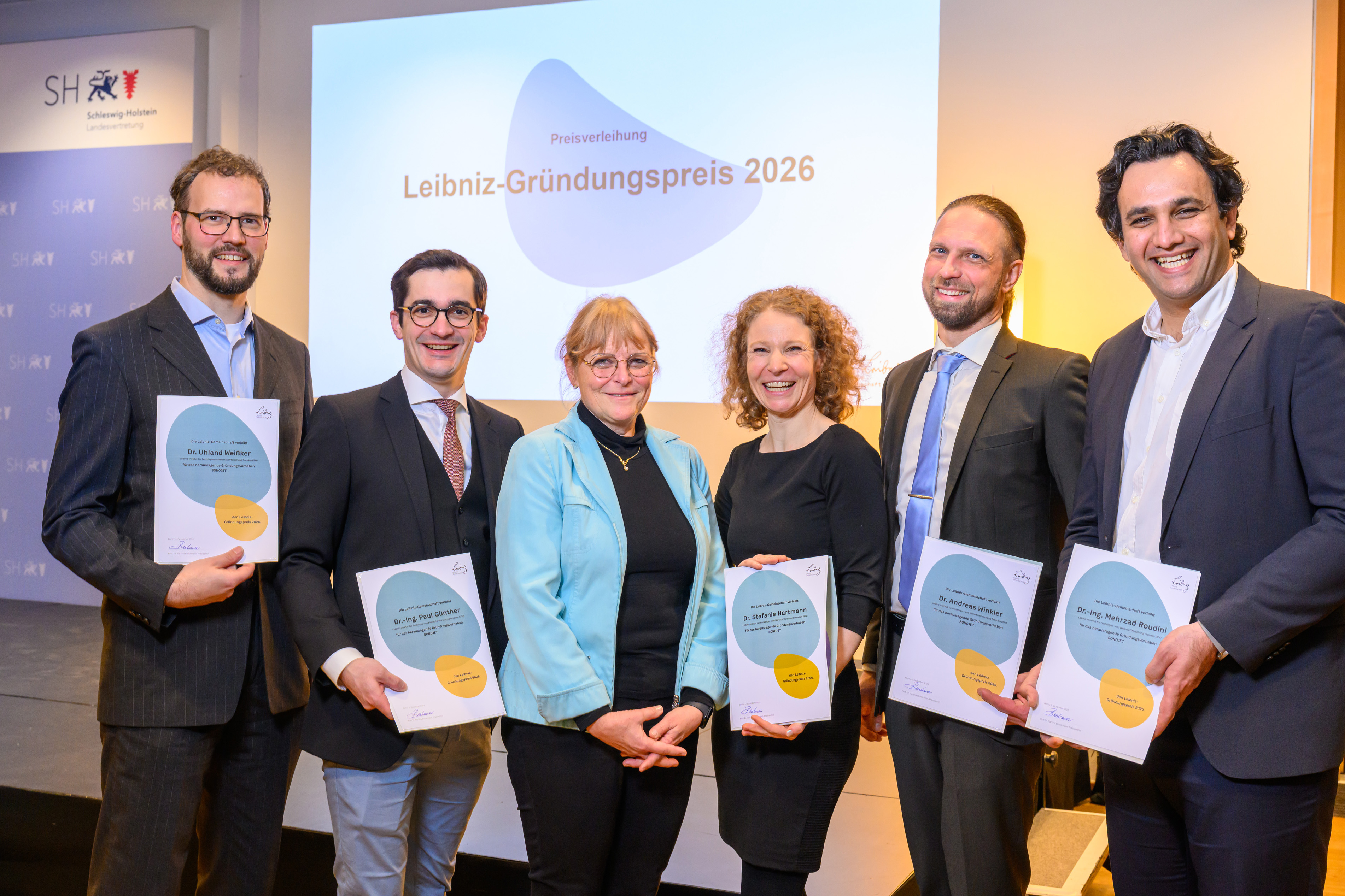
The Leibniz Start-up Prize 2026, endowed with 50,000 euros, is awarded to SONOJET, a spin-off from the Leibniz Institute for Solid State and Materials Research Dresden (IFW Dresden). With a new aerosol jet printing technology, SONOJET significantly advances industrial microprinting in the semiconductor and electronics industries. In recent years, aerosol jet printing has emerged as a highly promising technology for producing printed electronics on 3D surfaces, offering decisive advantages over established printing processes.
The aerosol printhead—based on a new technology developed at IFW Dresden and serving as SONOJET’s core product—overcomes the technical limitations of previous systems. The required aerosol is generated efficiently via an integrated, chip-based microacoustic aerosol source. At the same time, the printhead features a compact design and a greatly simplified system architecture. SONOJET also enables printing with a wide range of functional inks and uses expensive printing materials, such as precious-metal inks, in a highly resource-efficient manner.
This allows SONOJET to manufacture printed electronic components such as conductive traces, antennas, or sensors directly on 3D parts, housing components, or flexible substrates. Application areas include consumer electronics, automotive engineering, medical technology, and the defense sector, among others.
SONOJET was founded as a limited liability company (GmbH) in May 2025. The start of operational business is planned for mid-2026. Through 2026, the start-up will continue to benefit from funding from the German Federal Ministry for Economic Affairs and Energy’s “EXIST Research Transfer” program. In recent years, technology development has additionally been supported by project funding from the Federal Ministry of Education and Research, the Free State of Saxony, and the German Research Foundation (DFG).
SONOJET intends to use the prize money from the Leibniz Start-up Prize to participate in international industrial trade fairs and to professionalize its marketing activities. In the near future, the company plans to finalize the printhead for market entry and to develop a simple, integrated complete printing system.
The SONOJET founding team consists of:
Stefanie Hartmann is a physicist with a PhD and brings 15 years of experience as a business development and innovation manager. She serves as Managing Director and is responsible for financing strategy as well as customer and capital acquisition.
Mehrzad Roudini acts as SONOJET’s lead scientist. The mechanical engineer with a PhD has more than ten years of experience in aerosol generation.
Andreas Winkler, a materials scientist with a PhD, leads the technical pre-development. His expertise lies in microsystems fabrication and related analytics, as well as in R&D project management.
Uhland Weißker heads automation and device integration. The solid-state physicist with a PhD has worked in recent years on prototype development and device integration for aerosol generation.
Paul Günther is a materials scientist with a PhD and will be responsible at SONOJET for product development, manufacturing, production management, and quality management.
More about SONOJET at:www.sonojet.com
About the Leibniz Start-up Prize
The Leibniz Association’s Start-up Prize supports spin-off projects from Leibniz institutes in the preparation and start-up phase. The prize money of 50,000 euros is earmarked and may be used for support services to review and practically implement business concepts—especially for challenges such as market entry, raising financing, or developing marketing and sales strategies. The award is decided by a prize jury of the Leibniz Association composed of internal and external members.
Press Contact
Patricia Bäuchler
Email: p.baeuchler[at]ifw-dresden.de
Phone: +49 (0) 351 - 4659 249
Press Contact for the Leibniz Association
Christoph Herbort-von Loeper
Phone: +49 (0) 30 - 20 60 49 471
Email: herbort[at]leibniz-gemeinschaft.de
The Leibniz Association
The Leibniz Association unites 96 independent research institutions. Its spectrum ranges from the natural, engineering, and environmental sciences to economics, spatial and social sciences, and the humanities. Leibniz institutes address questions of social, economic, and ecological relevance. They conduct both fundamental and applied research, including within cross-institutional Leibniz Research Alliances, operate or maintain scientific infrastructures, and provide research-based services. The Leibniz Association places strong emphasis on knowledge transfer, especially through the Leibniz Research Museums. It advises and informs policy makers, academia, industry, and the public. Leibniz institutions maintain close cooperation with universities—among other things via Leibniz ScienceCampi—as well as with industry and other partners in Germany and abroad. They are subject to a transparent and independent evaluation procedure. Because of their national importance, the institutes of the Leibniz Association are funded jointly by the German Federal Government and the federal states. Leibniz institutes employ around 21,400 people, including 12,200 scientists. The total budget amounts to just over 2.3 billion euros.