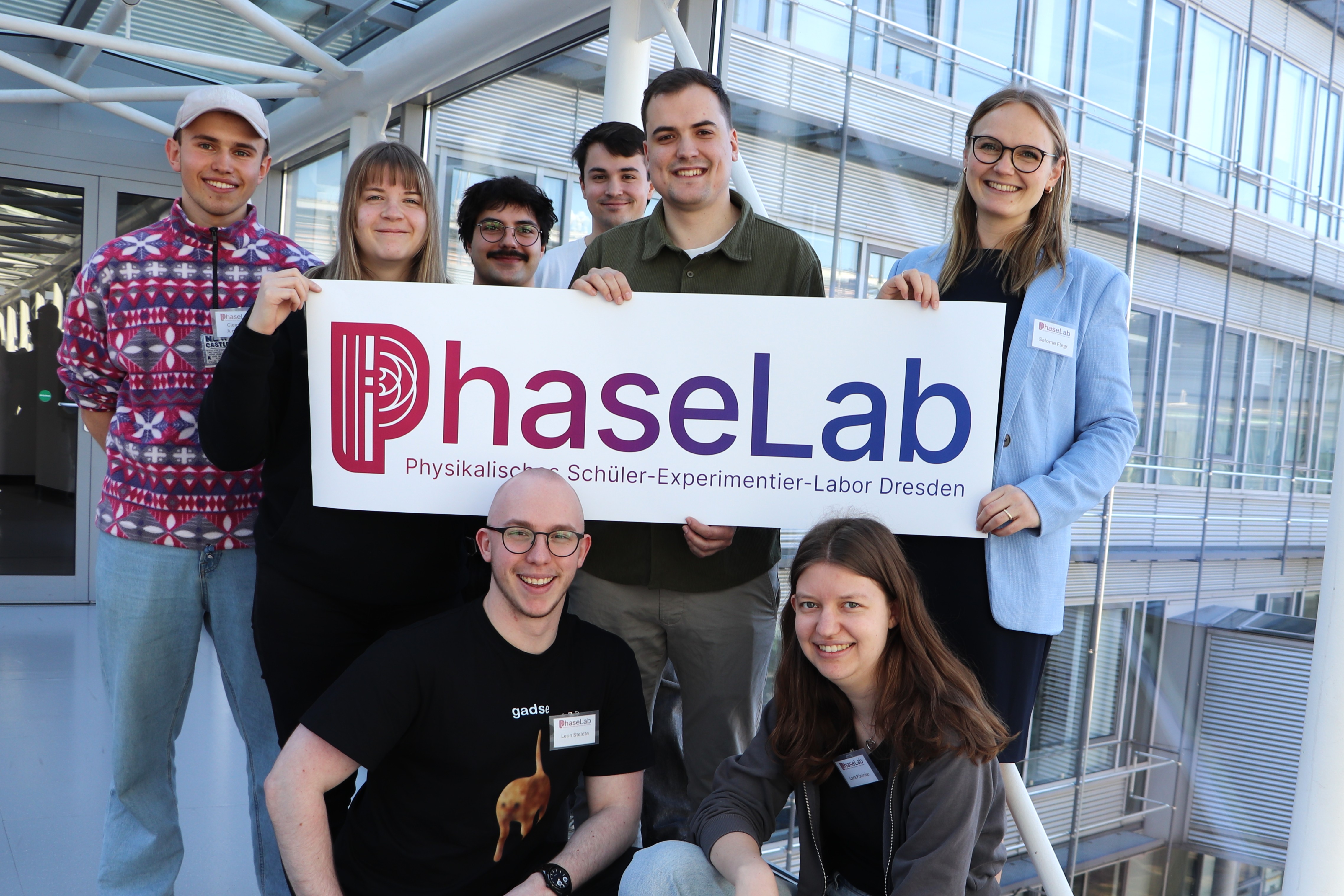
From February 25 to March 6, 2026, the newly developed PhaseLab student laboratory for quantum physics celebrated its launch at the Leibniz Institute for Solid State and Materials Research Dresden (IFW Dresden). Around 180 twelfth-grade students visited the institute during this period to engage intensively with fundamental concepts of modern physics. The program was organized in cooperation between the Chair of Physics Education at Technische Universität Dresden (TU Dresden) and IFW Dresden and is planned to take place regularly in the future.
Over the past two weeks, participants had the opportunity to explore the fundamentals of quantum physics experimentally outside the regular school curriculum. As the required experimental setups are often only available to a limited extent in schools, students at IFW Dresden were able to conduct (analogy) experiments independently and gain insight into modern scientific working methods.
The PhaseLab student laboratory pursues three main objectives: supporting school students, providing practice-oriented training for pre-service physics teachers from the TU Dresden physics education program, and advancing current research in physics education on how students understand quantum physics concepts. The participants worked on key aspects of quantum theory such as polarization, interference, superposition, complementarity, and entanglement. In addition, digital simulations and a newly developed augmented reality environment were used. The accompanying research in this first round investigated how visualizations can support the understanding of complex quantum physics concepts.
Junior Professor Dr. Salome Flegr (TU Dresden) emphasizes the program’s multiple benefits:
“PhaseLab creates a win-win-win situation for education: upper secondary school students can conduct key analogy experiments in quantum physics themselves, while pre-service physics teachers gain their first experience working with experiments and supporting learners. At the same time, our accompanying research provides valuable insights for the future design of learning materials.”
The teachers who participated in this first round were enthusiastic:
“We are delighted that the students can carry out analogy experiments themselves here. Everyone was highly motivated and actively engaged. We would be very pleased if the program could continue and we could return in the future.”
For IFW Dresden, participation in the student laboratory is also an important contribution to fostering young scientific talent. Prof. Dr. Bernd Büchner, Scientific Director of IFW Dresden, explains:
“Encouraging young people with an interest in science and thereby supporting the development of future researchers is very important to us. Complex experimental setups are often difficult to implement in regular school lessons. As an extracurricular learning venue, we want to provide a platform for the topics researched at our institute and help strengthen quantum physics education in Saxony in a sustainable way.”
The student laboratory is funded by the SAX-QT network (Saxon Research Network for Quantum Technologies), which supports the expansion of research, education, and technology transfer in the field of quantum technologies in Saxony. In addition, the Wilhelm and Else Heraeus Foundation supports the student laboratory by funding accompanying student assistants, digital technologies, and experimental setups.
Contact:
Patricia Bäuchler
Science Communication, IFW Dresden
p.baeuchler[at]ifw-dresden.de
PhaseLab Contact for Teachers:
Alexander Schuster
Research Associate, Chair of Physics Education (TU Dresden)
alexander.schuster[at]tu-dresden.de