contact: V. Geske, J. Freudenberger
Cost-effective and highly repeatable processes to repair and overhaul gamma-TiAl blades instead of using newly produced ones has become more and more urgent in recent years. An approach towards a more feasible and easier adoption of repair welding by industry is to reduce the needed number of welding feedstock wires from two to one by combining Ti and Al into a single composite wire.
Together with our partners at the Günter-Köhler Institute for Joining Technology and Materials Testing (ifw Jena), we started the DFG (project no. 553318092) funded project "Additive manufacturing of titanium aluminide high-temperature alloys by means of wire-based laser-assisted direct energy depostition" in February of 2025. The IFW Dresden develops the welding wire by metal forming (especially swaging) suitable for Direct Energy Deposition, while the ifw Jena optimizes the welding device and process.
T. Marr et al. Metals 2013, 3, 188-201
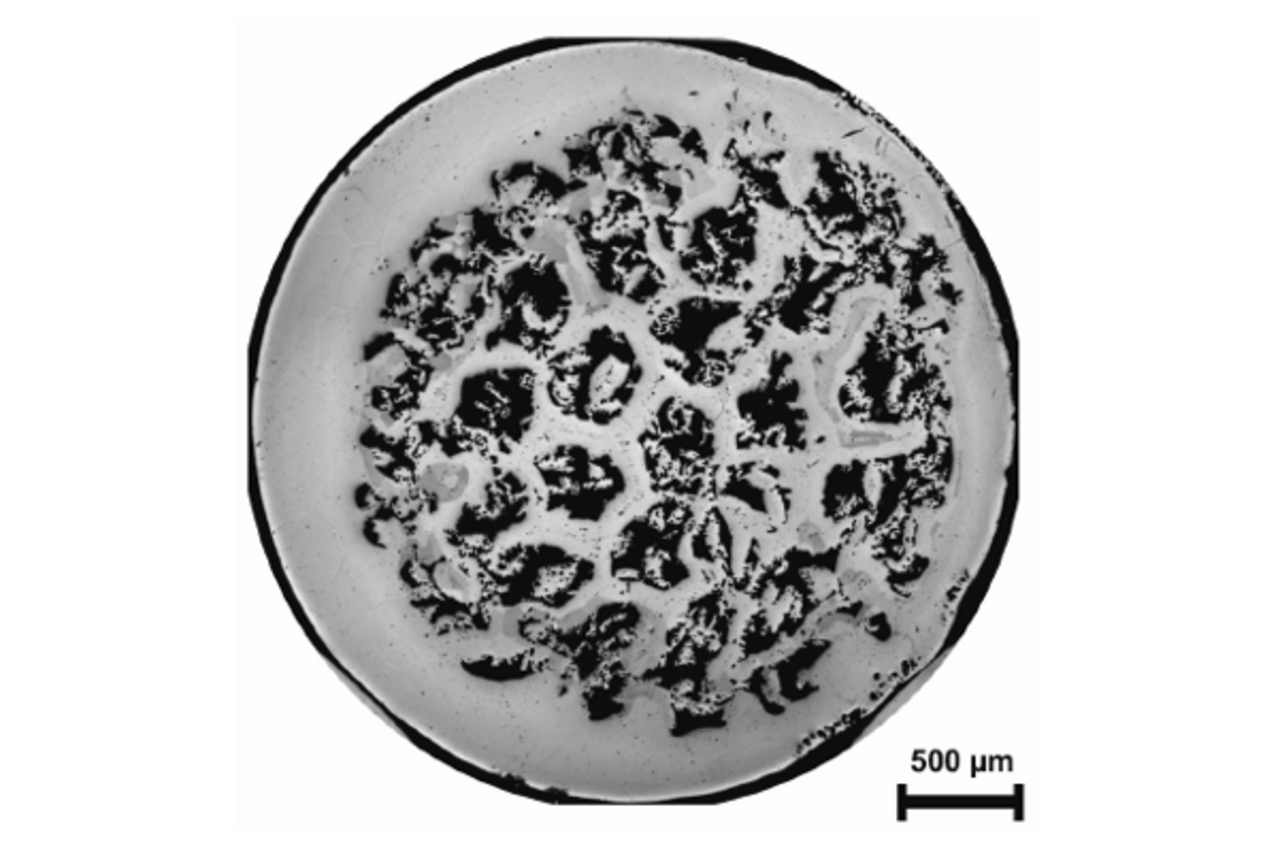
This study shows the possibility of processing titanium aluminide wires by cold deformation and annealing. An accumulative swaging and bundling technique is used to co-deform Ti and Al. Subsequently, a two step heat treatment is applied to form the desired intermetallics, which strongly depends on the ratio of Ti and Al in the final composite and therefore on the geometry of the starting composite. In a first step, the whole amount of Al is transformed to TiAl3 by Al diffusion into Ti. This involves the formation of 12% porosity. In a second step, the complete microstructure is transformed into the equilibrium state of γ-TiAl and TiAl3 . Using this approach, it is possible to obtain various kinds of gradient materials, since there is an intrinsic concentration gradient installed due to the swaging and bundling technique, but the processing of pure γ-TiAl wires is possible as well.